The Past, Present, and Future of the LLM Wiki

In April 2026, Andrej Karpathy — co-founder of OpenAI and one of the most-followed voices in AI — published a short note describing exactly this setup: the "LLM Wiki." No product, no code, no company — just a recipe.
Three months later, the idea has gone viral, drawn product responses from Google and Anthropic, and sparked a debate about what comes next. How did we get here? Where are we now? And where is this going?
The Past: Where the Idea Came From
The viral moment
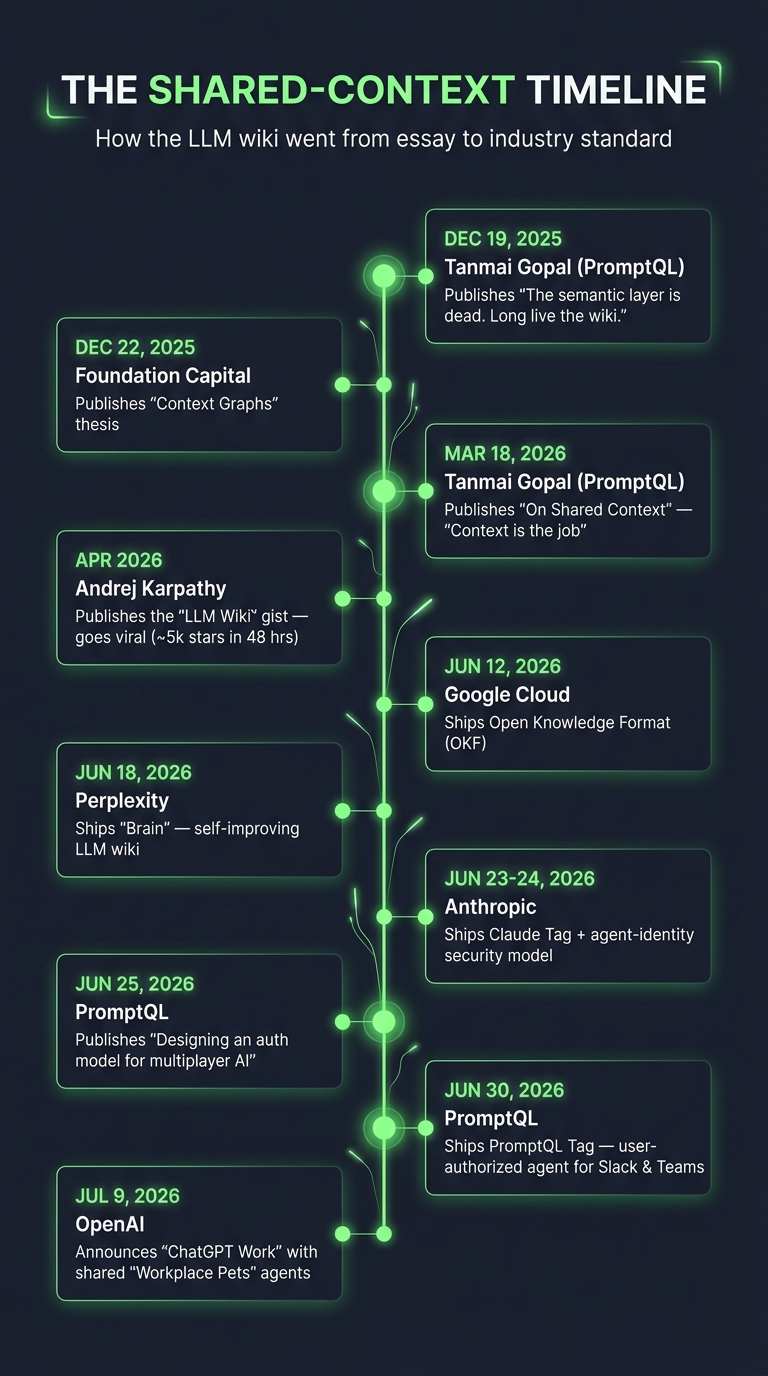
Karpathy's gist — a simple markdown file on GitHub — earned 5,000+ stars and 1,294 forks within 48 hours, and roughly 300 points on Hacker News. By mid-April, it had 17,776 stargazers (dataset).
The core idea was elegant. Instead of feeding AI a random grab-bag of document snippets every time you ask a question (the standard "RAG" pattern), you maintain a persistent, organized knowledge base — a wiki — that the AI reads and updates over time. Karpathy described three layers: raw sources, a curated wiki, and a schema file that tells the AI how to navigate it. He called it "Obsidian is the IDE; the LLM is the programmer; the wiki is the codebase."
He wasn't selling anything. He was just describing what he had built for himself — roughly 100 articles, ~400,000 words, all running on his laptop.
But the idea came earlier
The honest way to say it: Tanmai wrote down the wiki-as-shared-memory idea months before Karpathy's note existed — and had a working product built on it. Karpathy made the idea famous.
On December 19, 2025, CEO of Hasura, Tanmai Gopal published "The Semantic Layer is Dead. Long Live the Wiki." — arguing that the old way of organizing data for business intelligence (the "semantic layer") was being replaced by something more natural: a living wiki that maps how people actually talk to how data is actually structured.
Then on March 18, 2026, he published "On Shared Context", laying out seven principles for how teams should share knowledge with AI. The central line: "Context is the job."
So Karpathy didn't invent the LLM wiki. What made Karpathy's note land so hard was that he gave a name and a shape to something many people were already feeling. The frustration with "RAG" — dumping documents into a bin and hoping the AI grabs the right ones — was widely shared. He made it viral.
The Present: The Trend Goes Mainstream (July 2026)
Something interesting happened in July 2026. Three major companies — Google, Perplexity, and Anthropic — all shipped products built around the same idea. It was no longer a gist. It was an industry.
Google formalizes the format
On June 12, 2026, Google Cloud published the
Open Knowledge Format (OKF)
— "an open specification that formalizes the LLM-wiki pattern into a portable, interoperable format." The spec is
deliberately minimal: markdown files with YAML frontmatter, only one required field (type), and the rest is optional.
It fits on a single page.
Google explicitly credits Karpathy's gist: the announcement quotes him saying, "LLMs don't get bored, don't forget to update a cross-reference, and can touch 15 files in one pass."
The message is clear: this isn't one company's feature. It's a format. And Google is betting that "the value of a knowledge format comes from how many parties speak it, not from who owns it."
Perplexity ships "Brain"
On June 18, 2026, Perplexity launched Perplexity Brain — a self-improving memory system for their "Computer" agent. The launch post says: "The context layer takes the form of an LLM wiki that's automatically loaded onto the agent sandbox."
The wiki pages reflect "ideas, people, projects" and update overnight. Every entry links back to the source it came from. And Perplexity published hard numbers: +25% answer correctness on repeat tasks, +16% recall, −13% cost.
This is the first time a major consumer AI product has shipped a wiki as a core feature — not a side panel, not a memory bank, but the context layer itself.
Anthropic ships "Claude Tag"
On June 23, 2026, Anthropic announced Claude Tag — a way to add Claude to your Slack channels as a team member. On June 24, they published a deeper post on "Agent Identity," describing how Claude gets its own accounts and permissions within your workspace.
Their framing is direct: "Agent identity replaces the question 'what can this user do?' with 'what can this agent do in this compartment?'" They also note that "the teams that get the most out of Claude are the ones that grant it generous access from the start."
This is a different angle on the same problem. Instead of asking "how do we give the AI the right context?", Anthropic asks "how do we give the AI the right access?" Both answers converge on the same need: a shared, structured, persistent knowledge layer that the AI can read and write.
PromptQL ships its own answer: PromptQL Tag
One week later, on June 30, 2026, PromptQL shipped PromptQL Tag — its own way to bring the agent into external platforms like Slack and Microsoft Teams. The appearance is similar. However, the design philosophy is the opposite of Claude Tag's. We will discuss about it on another topic.
OpenAI ships "ChatGPT Work"
On July 10, 2026, OpenAI announced ChatGPT Work — a way to "bring together context from your team’s tools to turn scattered notes, drafts, and ideas into finished work — and keeps projects moving while you stay in control".
The idea is similar: ChatGPT Work collaborates with AI on projects in a shared workspace, distinct from personal storage, and connects with your workspace tools (Slack, Teams).
The Future: Where This Goes Next
So we have a viral idea, a formal specification, and three major product launches. What happens next?
What people say is still missing
Read the online discussions about Karpathy's note and Google's format, and the same three complaints come up again and again:
- Who keeps it up to date? Google's format is a snapshot — a box of knowledge you hand over. Nothing in it updates itself.
- It's built for one person, not a team. As the Towards AI analysis bluntly put it, these file-based setups have "no RBAC mechanism" — tech-speak for no way to control who sees what. There's also no protection when several AIs edit the same page at once, and no tamper-proof record of changes — a dealbreaker for banks, hospitals, or anyone with auditors.
- Who checks the AI's work? Everyone agrees AI-written pages drift out of date and accumulate errors without review. Nobody agrees whose job the reviewing is.
Keep that list in mind. It's exactly the difference between a personal notebook and a company knowledge system.
One person's wiki vs. a company's wiki: same idea, different game
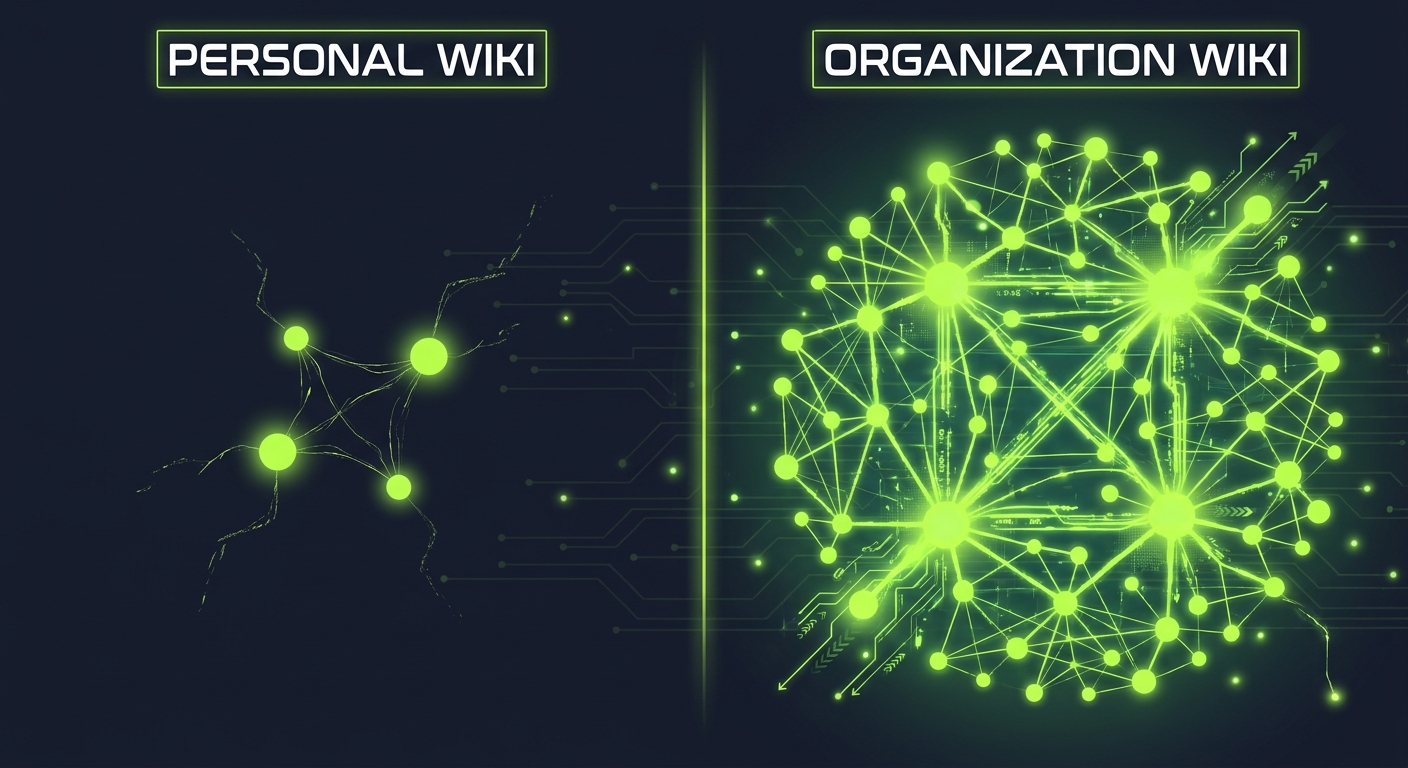
Karpathy's design and PromptQL's design agree on the basics: knowledge lives in simple pages, one topic per page; pages link to each other; the AI does the tedious upkeep. From there, they part ways on almost everything:
| Karpathy's LLM Wiki | PromptQL's wiki | |
|---|---|---|
| Who uses it | One person, on their own computer. | A whole team or company, together. |
| How it updates | You drop in documents; the AI files them; you tidy up alone. | The AI proposes updates from real work; a teammate reviews and clicks "Add to wiki." Nothing enters the shared brain without a human OK. |
| What it's connected to | Nothing — it sits beside your reading list. | The company's actual databases and business tools, so the AI can act on what it knows, not just recite it. |
| Quality control | Personal discipline. | Wikipedia-style: page history, named authors, review before publishing. |
| Security | Whatever your laptop has. | Every person's permissions are enforced. The AI acting for you can only see what you can see. |
| Scale | One very smart user's reading. | An organization's collective know-how, shared between the people who know and the people who ask. |
Karpathy himself mentioned the team version — an internal wiki fed by Slack messages, meeting transcripts, and customer calls — but explicitly left it as a thought, not something his recipe builds. Google's format standardizes the packaging of knowledge, not the upkeep. Even Perplexity's Brain — the most polished product version — is a personal wiki for each subscriber, not a shared company one.
That gap — between a personal notebook and a living, shared, supervised, connected company brain — is exactly the list of missing pieces the community keeps naming. It's also exactly what PromptQL built.
The compounding loop
Satya Nadella captured the long-term vision in a June 2026 post: "This is the first time we can create a real cognitive loop between people and digital systems. This loop becomes the new IP of the firm. I think of it as a hill-climbing machine. And unlike most assets, it compounds."
He's describing exactly what an organizational LLM wiki enables. Every conversation, every decision, every query — instead of evaporating into Slack history or email archives — becomes part of the company's institutional memory. The AI gets better because the wiki gets richer. The wiki gets richer because the AI helps capture and organize what people know.
This is the future PromptQL is building: not just a chatbot that answers questions, but a shared knowledge system that makes the whole organization smarter over time.
The security question
The most important debate in the next 12 months won't be "should we use a wiki?" It will be "who controls it?"
Anthropic's Claude Tag takes the "self-authorized" approach: give the AI its own identity, its own permissions, and let it operate independently. As their blog puts it: "grant it generous access from the start."
PromptQL takes the "user-authorized" approach: the AI borrows your badge. It can only see what you can see. It acts on your behalf, with your permissions, in your context. This prevents the "confused deputy" problem — where an AI with broad access is tricked into leaking data it shouldn't.
On June 25, 2026 — one day after Anthropic's post — we published "Designing an auth model for multiplayer AI", making the case that user-authorized security is the only model that scales to regulated industries, multi-team organizations, and audit requirements.
The future will likely include both models. But the enterprise default will be user-authorized — because "generous access" is a liability when the AI is handling customer data, financial records, or health information.
Why bother? Because AI without company knowledge mostly fails
Two independent research results explain why this matters in money terms:
- MIT found that 95% of corporate AI pilot projects fail to show measurable business results (Fortune, Aug 2025). The projects don't fail because the AI is dumb. They fail because the AI doesn't know the business.
- UC Berkeley tested the best AI models on realistic company-data questions (Data Agent Benchmark, 2026) — the kind where information is scattered across several systems that don't quite agree with each other. The best model in the world got the right answer only 38% of the time on the first try. You would never let a coin-flip answer your board questions.
The missing 62% isn't a smarter model. It's the tribal knowledge every company runs on: what "active customer" means here, which of the four revenue columns is the real one, why the region codes changed in 2024. That knowledge lives in people's heads, unevenly. Getting it out of heads and into a form AI can use is, at its core, a sharing problem — and Tanmai's "On shared context" lays out the principles: capture knowledge during work, not in documentation projects nobody finishes; let the people who know review and correct it; let it build up instead of evaporating. The essay's thesis — "Context is the job" — is Nadella's "hill-climbing machine," said plainly, three months earlier.
PromptQL's version in practice: every conversation with the AI can end with the AI suggesting wiki updates based on what it just learned. A human approves them. The next conversation starts smarter. That's the "cognitive loop" — shipped, not envisioned.
The LLM Wiki becomes Shared Context
Three months after a famous researcher's weekend note, the industry has converged: AI's memory won't be a pile of document fragments. It will be a living, compounding wiki.
The personal LLM wiki was a breakthrough, but the endgame for major tech companies is something much bigger: shared context.
Every major player is converging on the same truth. OpenAI Work, Claude Tag, Perplexity's Brain, and Google's Open Knowledge Format aren't just about organizing personal files—they are attempts to solve the enterprise multiplayer bottleneck. As Microsoft CEO Satya Nadella put it, when people and digital systems share a cognitive loop, that loop becomes "the new IP of the firm... a hill-climbing machine" that compounds over time.
The semantic layer of the past organized structured data for dashboards. The shared context layer of the future organizes unstructured knowledge, tribal rules, and execution context for agents. As PromptQL and others have shown, the companies that win the AI race won't be the ones with the smartest models—they will be the ones with the best shared context.